Pages

Sunday, 11 November 2018

Treat day

I had the day off on Friday 02/11, given to me by work as it was my birthday the following day. The Mrs and everyone else I knew was at work, so there was no choice but to go out birding for the day. Poor me!

I had a plan in mind to set off early and get up to Thrapston, to see the group of 6 1st-winter Velvet Scoters that had taken up residence on Town Lake since the previous Sunday. It looked likely I'd miss out on this valuable county tick, but miraculously, they had hung on for me.

Friday was a beautiful bright, crisp day and ideal to be out and about. I made my way to the southern side of town lake, hoping the scoters would still be in situ. I eventually found a gap in the lake side trees to view a reasonable amount of the lake.

Relief soon enveloped me, as a single Velvet Scoter appeared in my bins, loosely associating with a group of Tufties. I walked further along and after a bit of effort, found another opening in the trees to enjoying closer, better views of the bird.


After a while, a second Velvet joined it and then the other 4 appeared a little later too, in the middle of the lake. I don't know where they were all hiding but now all 6 were in view! I spent some time getting lovely scope views and also picked out the recently reported 1st-winter Scaup too. Bonus!


It was now 10 o'clock and I was mulling what to do next. Either I mooched around a few county sites to try and find something OR, being well on the way to Norfolk, would it be a bit mad to go there for the afternoon?


Well, I'd realised that I had spent so much of 2018 patch birding and keeping it local, that I'd yet to see a lifer at all this year. So with the lure of of the probable Stejneger's Stonechat & King Eider in North Norfolk, I was soon heading around the Peterborough ring road and on towards Kings Lynn! Calling my Norfolk mate Kieran, he was luckily free and so we agreed to meet at Salthouse beach road, about 12:45pm. 

The possible Stejneger's Stonechat was a short walk away, along the Meadow Lane track. To be honest, we thought it would be relatively straightforward, particularly as it had been reported a few times already during the morning. But, for a good half hour it went AWOL! Thankfully though, someone else picked it out not too far from where we were. It certainly is a distinctive bird, with a noticeably white throat, pale underparts and a peachy rump which was not easy to see but could occasionally be seen when the bird was at rest. With DNA obtained from it's poo, we all await the results with interest!


Just after 2 o'clock, we hopped in our cars again and headed along to Sheringham. Just right of the seawatching shelter were several others already looking. After a brief scan with the bins, the 2nd-winter King Eider was duly located and there was my second UK lifer of the day! We soaked up the bird for a good 20-30 minutes, watching it diving for crabs. The light was immense and while it was a scope job to see it, the views were not to be sniffed at! We had a quick look for Purple Sands on the rocks down by the public toilets, but just the usual Turnstones were in situ.


With it now 3pm, I had about an hour and a half until sunset. Enough time then to finish the day at Stiffkey to look for raptors, before getting home for dinner! I therefore parted ways with Kieran and wound my way along the coast road to Stiffkey.

I walked a short way west from the campsite car park and set the scope up. No more than a minute later, a female Merlin flew past west, really close by before setting off after some Mipits. Better was then to come with a fairly distant but fantastic male Hen Harrier, slowly making it's way west, pausing several times to half-heartedly chase something before carrying on it's path. Well that was all rather easy and seemed like the ideal way to end the day.


Monday, 5 November 2018

Back to tradition

As is generally tradition, I managed once again to squeeze in a few days in North Norfolk in mid-October, in the hope that the wind had an easterly theme!

My pal Kieran again showed spot-on hospitality by putting me up and it was wicked to properly catch up again.

I spent the first two days of my 4-day visit birding by myself, as Kieran had to look after his little daughter. The first day, Sunday was in all honesty a right old washout, with horizontal rain all the way there and for the majority of the day.

I tried my best to get out and find something, but it weren't easy! A scan at Thornham across the saltmarsh, in a brief break in the rain produced a redhead Goosander, several Rock Pipits, a Red-Throated Diver, a Pintail, flocks of Brents & Pinkfoots and a selection of waders, including 3 Greenshank.


I tried nearby Gypsy Lane near Titchwell and Titchwell church, but both were unsurprisingly devoid of passerines. I decided to carry on E and spend a chunk of the afternoon seawatching off Cley with the wind showing a bit of NW.


It wasn't too bad, straight away encountering 2 Snow Buntings at point blank range in the car park. Best birds seen on the sea included 2 Arctic & 1 Sandwich Tern, c10 Bonxies, 1 Manx Shearwater, several Eider and plenty of Gannets.


The next day, Monday 15/10, I decided to give Sheringham a go early for a seawatch. It was pretty squally with a strong NE wind, plus Sheringham is only 15-20 mins from Kieran's, so perfecto!

It was a busy 3 hours, hardly mental, but lots of interest. The Little Gulls, Red Necked Grebe and Manxies were probably the highlights:


I then moved further west for the afternoon to give Wells Woods a go, as with the NE wind, I fancied there being a reasonable chance of finding something a bit tasty. After all...it's got just a bit of a track record!

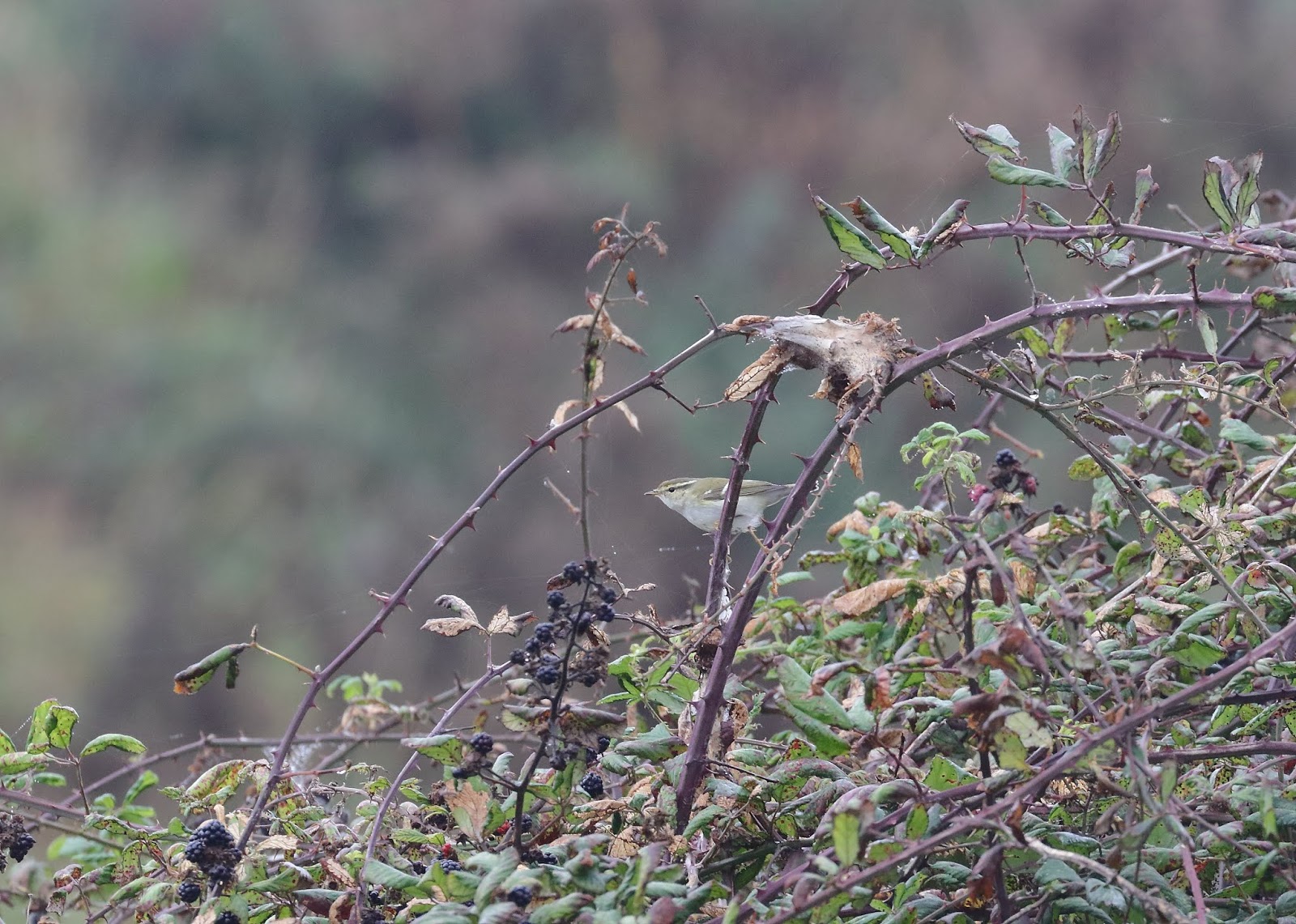
I love slowly making my way round there, always hopeful an OPB will flick up, or one of the Robins, morphs into a Bluetail. In reality, on this occassion, it wasn't so amazing, however I did come across my first Yellow-Browed Warbler of the autumn. A couple each of Brambling and Redpoll went over calling, while there was also a small smattering of Chiffchaff, Blackcap and Redwing, plus a notable number of Robins too, presumably mostly migrants.


The next two days I had company, with Kieran now free to bird, as his wife was now off work and able to look after their little one. The anticipation was high with far calmer weather forecast, following 2-3 days of minging weather and NE wind.

We spent Tuesday 16/10 birding Kieran's patch along the coast near Trimingham. It was as good a place as any to turn up something juicy, with plenty of decent areas to try.

As it turned out, we were straight into something very good! In the first 15 minutes of decent light, we saw a few Brambling, 2-3 Blackcaps and a surprise House Martin W. Then, around 5 minutes later, we reached a scrubby, grassy, more open area along the cliffs. Simultaneously, we heard a distinctive soft tack coming from the grass and dead weeds, a short distance to our left. We both knew full well what it was...a Dusky Warbler! We inched our way a little closer and were able to hear it really well for a good 10 minutes, as well as gain the briefest, classic Dusky views, as it scratted around in the dead weeds and long grass. See a recording of it here: https://www.xeno-canto.org/439999

Now that was some start to the day!! With appetite suitably whetted, we carried birding the rest of the area.


Unsurprisingly, there was nothing else as rare as the Dusky, however we still had a very decent day's birding with highlights including a Lapland Bunting, a fresh-in Yellow-browed Warbler in undercliff scrub, a Jack Snipe in-off and late Whinchat & Wheatear.


Just as interesting was watching birds coming straight in-off the sea too. This, included regular groups of Starling, Redwing, Skylarks, Bramblings and Chaffinches. An exciting sight!


On the ground there were impressive numbers of Robins and Song Thrush, particularly on the undercliffs, while the scrub had a decent sprinkling of Goldcrests and Chiffchaffs too. All in all, a really interesting day.

Wednesday 17/10 was my last day in Norfolk. We once again made our way around the cliffs at Trimingham. There were still birds about, however we didn't find anything too new. Best bird was probably a rather late Willow Warbler. There were more Fieldfare and Redwing about, flocks of Golden Plover & Pinkfeet overhead, 4 Grey Wagtails through W, several Brambling and an impressive number of c200 Chaffinch over W early on.


I then gradually made my way home along the N Norfolk coast. I stopped off at Stiffkey Campsite Wood for a prolonged look about. Rather predictably, I came across a Yellow-browed Warbler, feeding with c10 Goldcrests at the W end of the wood. A Brambling was the only other bird of note, despite a meticulous search.


There ended an enjoyable few days and a welcome change of birding scenery!

Tuesday, 25 September 2018

It couldn't happen again...could it?!

This week saw the first autumnal gales of the year and as such, attention turned to the possibility of displaced seabirds. With such rewards in my mind, I've spent quite a lot of time on the Grimsbury Res patch.

Following the remnants of tropical Storm Florence earlier in the week, Storm Bronagh soon arrived on Thursday 20/09 & Friday 21/09, with strong westerly / north westerly winds hitting the UK. This one got things going and a good number of Grey Phalaropes began popping up all over the place.


Finding a Grey Phalarope at Grimsbury Res last September was so exciting but surely it couldn't happen again could it?! Well, both early morning, before work and on my lunch break, I drew a bland on finding pretty much anything to be honest. But, seeing how many Grey Phals and other seabirds were continuing to be found elsewhere, I persevered and visited again about twenty past five, after work.

On reaching the res, I began scanning and quickly found a Polish-ringed Black Headed Gull on the pontoon. Further scanning along the east side produced a small, gleaming white shape towards the SE corner. It soon moved and turned...a Grey Phalarope!!


It wasn't possible to view it from the E side as the view along this section of shoreline is blocked by a long stretch of concrete step. So it took a while, but eventually it ventured out into unobscured shoreline allowing myself and local birder Steve Holiday to enjoy this characterful little juvenile/1st-winter. I hadn't realised he wasn't around for last year's one, so it was great Steve got to see this one.


Gareth & Colin arrived too and having watched the bird for a while, we went on to see a decent supporting cast before dusk, including 6 Golden Plovers through, 1 Hobby, 1 Little Egret (scarce here) & c5 Yellow-Legged Gulls into roost.

The next day, (Saturday 22/09) I just had to go back to see the Phalarope again and so arrived nice and early. It was very much the calm following the storm, however still produced some interesting birding. There was unfortunately and rather surprisingly, no sign of the Phalarope, though under cloudy skies, there was a lot of overhead vis mig between 07:25 - 09:40. A total of at least 453 Meadow Pipits moving S was very impressive, as were 35+ Siskins in dribs and drabs, though there were certainly more than that, with many more distant calls heard. A flyover Yellowhammer was a welcome patch year tick, probably my last Yellow Wagtail of the year went S and a Snipe zoomed through NE.

More than satisfied with what I'd seen, I decided to get home for some breakfast with the stomach rumbling! On leaving, I looked back one last time to see a species of tern rapidly dropping out of the sky! I marched back and was pleased to find it was a beautiful adult Arctic Tern. Get in! I sat and enjoyed it elegantly floating up and down the reservoir for a while and then it really was time for some food! My fourth patch year tick in 2 days...very good times!


Saturday, 22 September 2018

In search of waders

Last weekend, I made a bit of a last minute decision to go down to Somerset for the day to see my good mate Dan Watson who had relocated down there in recent months. On the Friday, he had found a juvenile Grey Phalarope at his newish local patch of Cheddar Reservoir, or the cheese bowl as it was becoming affectionately named! So it would be cool to see his find and possibly try a few sites along the coast, in the hope of perhaps finding an american wader.

I arrived mid morning and we were soon down at the reservoir enjoying the Grey Phalarope, pootling between the Teal and other wildfowl along the muddy shore at the northern end. It's always a treat seeing a Grey Phalarope, they're a bit of a crowd pleaser. It also evoked memories of the Grimsbury one last year which Dan came to see too, so somewhat role reversal this year!


After a while we headed off to walk along Berrow Beach on the Severn estuary coast, to look for waders. There were particularly good numbers of Sanderling (including quite a few juveniles), some 30 or so Knot, Oystercatchers, c5 Dunlin and a few Ringos. Nothing particularly out of the ordinary but nice to see all the same.


Our final destination was Steart a little way further along the coast. It is a vast site and I imagine it would be an excellent site in winter. But considering how big it was and how good the habitat looked, there was hardly anything there! That said, what was there was pretty decent, with a juvenile Curlew Sandpiper, c4 Spotted Redshank, c5 Greenshank, 1 Green Sandpiper and a Wheatear.


Before hitting the road home, we popped back into Cheddar Res for another fill of the Phalarope. Surprise, surprise a guy with a large bazooka-like camera lens was camped out along the shoreline. While this may not have disturbed the bird, it was probably unsettling the wildfowl and gulls about in that area. After Dan said a few words, he soon left and low and behold a good number of birds returned to this area. Say no more!

Sunday, 16 September 2018

The gulls again stealing the show

Having stayed overnight on Friday (07/09) with some of Em's family near Oxford, I gave Farmoor a visit first thing Saturday morning.

It was gloomy and drizzly and so promised much! A walk along the causeway and the full perimeter of F2 produced 100s of House Martins, enticing a couple of hunting Hobby. The juvenile Black Tern that had been about for a few days, was right out on a buoy in the middle of F2. Common Sand & Dunlin were seen briefly, while a close in Red Crested Pochard was nice. 


More interest came with a very approachable juvenile Great Black Backed Gull. It was rung, (JJ808) and appears to be from a scheme in southern Norway. I've e-mailed them and await a response.


The highlight though was a beaut of a classic juvenile Caspian Gull, that I initially ID'ed as a possible from the causeway, sat out on a buoy, but confirmed once closer, towards the southern end of F2 (phone-scoped pics below). It showed well together with several Yellow-Legged Gulls of varying ages.


Later on, having gone home and sorted out a few things, I decided to pop out again for a few hours, for bit of a tour of South Northants sites. I started at Daventry Country Park where there were lots of birds about. Scoping from the dam brought a Garganey, 7 Green Sand, 1 Pintail, 3 YLG and a Snipe, together with lots of Teal, Shoveler, Gadwall and gulls.

Nearby Borough Hill was relatively birdless, however 4 Whinchat close to the BBC compound, were cool!


On the way home, a couple of Yellow-Legged Gulls were the only things of note at Bodington Res, while there were at least 2 more amongst a large numbers of gulls following the plough close to Brackley.


Friday, 14 September 2018

You ain't "Cach"ing me out!

Monday 03/09/18 was a really good day on patch. It began with the rare discovery of an autumn Wood Warbler, foraging with a large tit flock on the edge of Grimsbury Wood. Great views were had, but not for very long and it managed to flick away just as the camera came out of the bag...of course! A Teal and a plastic Black Swan, both unusual visitors to the patch, added to the variety too.


The interest did not stop there. I popped in after work for another look. With heavy cloud overhead, I fancied something might drop in. It was all pretty quiet, however things were spiced up a little when some guy began flinging bread over the fence for the ducks! In very little time a juvenile Yellow-Legged Gull appeared and began fighting for the bread, together with a few Mallards and Black Headed Gulls


After a while, the YLG flew to the water, presumably to sit and digest it's bready treats! Another gull then circled in and joined it. This bird looked interesting and certainly a potential Caspian Gull, with a long, sloping head/bill, whitish ground colour and a distinct shawl forming around the neck. The barring on the scapulars were concerning me a bit, as was the underwing, which was whitish but not as bold as I have seen on Caspians before. I had a small hunch that it could perhaps be from a mixed colony. In fact, speaking to a couple birding friends later, they also suggested the same.


It flew around a bit and on reviewing the photos it was ringed.


Later, blowing the pic up on the computer, I could read it as XEHA and indeed the CR birding website confirmed it to have originated from one of the east German mixed colonies. Ronald Klein, running this ringing project sent the following details on the bird:


I also sent pics to Ian Lewington and he kindly made the following comments:

I think yours looks good apart from the heavily barred greater coverts and scaps so I would guess it's also of mixed parentage. I think the underwing is OK for cach. Ronald Klien says there are a few Herring, Yellow-legged and LBb Gulls in the same colony.

So not a new addition to the Grimsbury year list, but plenty learned and a rare, opportunity to discover so much more about a particular bird!

Heatwave Emperors

This spring / summer's sunny weather continued through June, with temperatures hitting the 30s on a regular basis. A significant UK infl...