So the usual crowd of myself, Dave, Jon, Kirsty & Sam, kindly driven by Sam, headed off bright & early to Lynford. We waited a while before we began to see a smattering of Common Crossbill. We then had the briefest of views of a juvenile Two-Barred Crossbill before it flew.
However before too long we were enjoying views of it & an adult female, close to the visitor hut, get in!


We continued to watch before most of the Crossbills departed. Eventually several trickled back before a juvenile male & adult male (not seen by me I'm afraid, although I did hear it's rather different call) Two-Barred were located. A little while later they all departed & that was our cue to do the same. But what a couple of hours we'd had!


Next we headed on to the coast, to Cley. Here we checked out Walsey Hills & it wasn't too long before we were enjoying the long-staying female Red Backed Shrike. We had good views of it perched up & feeding on the western side of the reserve.


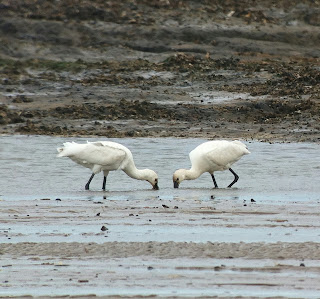
We ended the day at Titchwell, however failed to catch up with anything too spectacular. Best birds seen were 3 Curlew Sandpiper, 1 Little Stint, 2 Spotted Redshank, 2 showy Spoonbill on the beach, several Eider, a Sandwich Tern, several Gannets & good numbers of the usual waders.



Finally, back in the car park there was a surprisingly large number of Commas feeding on the blackberries with probably at least 15 perched up, along with a few Speckled Woods for good measure!


However before too long we were enjoying views of it & an adult female, close to the visitor hut, get in!


We continued to watch before most of the Crossbills departed. Eventually several trickled back before a juvenile male & adult male (not seen by me I'm afraid, although I did hear it's rather different call) Two-Barred were located. A little while later they all departed & that was our cue to do the same. But what a couple of hours we'd had!


Next we headed on to the coast, to Cley. Here we checked out Walsey Hills & it wasn't too long before we were enjoying the long-staying female Red Backed Shrike. We had good views of it perched up & feeding on the western side of the reserve.


We ended the day at Titchwell, however failed to catch up with anything too spectacular. Best birds seen were 3 Curlew Sandpiper, 1 Little Stint, 2 Spotted Redshank, 2 showy Spoonbill on the beach, several Eider, a Sandwich Tern, several Gannets & good numbers of the usual waders.


Finally, back in the car park there was a surprisingly large number of Commas feeding on the blackberries with probably at least 15 perched up, along with a few Speckled Woods for good measure!


No comments:
Post a Comment